
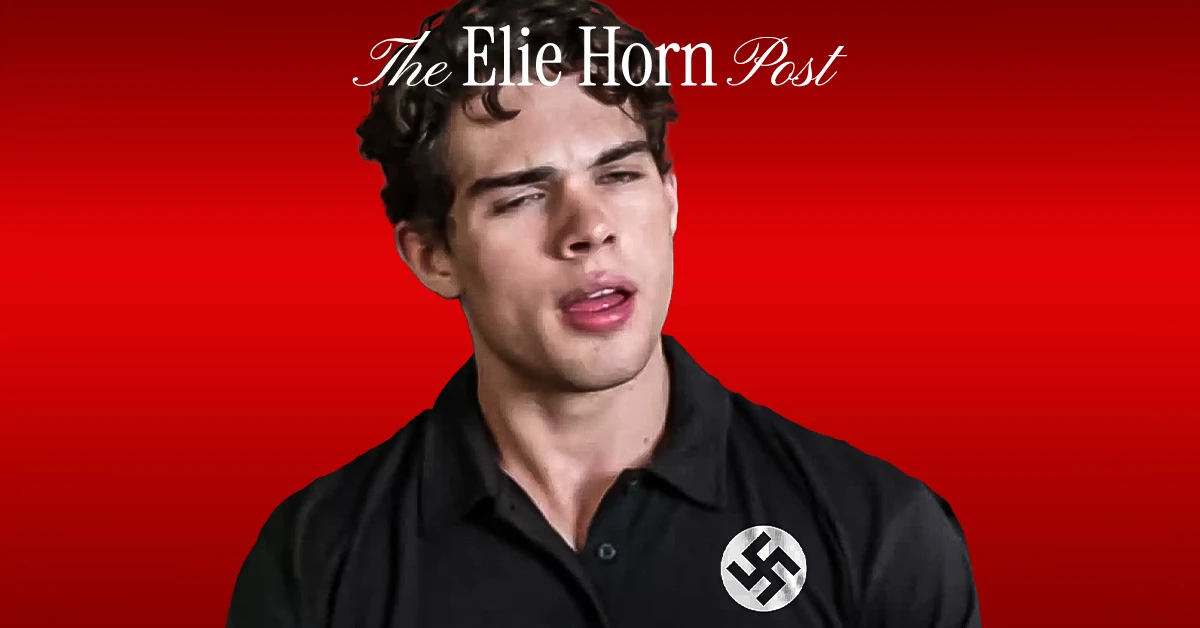
Just a few months after appearing in one of the internet’s most controversial antisemitism scandals, influencer Clavicular has found himself walking the streets of Tel Aviv.
For many Jewish observers, the visit has been difficult to understand.
Earlier this year, Clavicular appeared at a nightclub in Miami alongside Nick Fuentes, Sneako, Andrew Tate, Tristan Tate, Myron Gaines, and Justin Waller while Ye’s (Kanye West’s) song “Heil Hitler” blasted through the speakers. Videos showed members of the group singing along to the lyrics, and the footage quickly spread across social media. The nightclub later condemned the incident, several participants were banned from venues, and Jewish organizations described the event as deeply offensive.
Given that history, many Israelis were shocked to see Clavicular welcomed by several pro-Israel influencers during his recent trip. Photos and videos from the trip circulated online showing Clavicular enjoying Israel’s nightlife and spending time with young Israeli girls. While some creators viewed the visit as an opportunity to expose a massive online audience to Israel, others argued that giving attention to someone closely associated with antisemitic figures sends exactly the wrong message. The controversy became so intense that one Tel Aviv beach club reportedly asked Clavicular to leave after patrons recognized him and objected to his presence.
The biggest question many Jewish commentators are asking is simple:
Whose idea was this trip?
That question has only grown louder after Clavicular claimed during a livestream that officials from Prime Minister Benjamin Netanyahu’s office had contacted him and even asked him what would be the best way to “humanize Bibi” for Generation Z. If true, the claim would suggest an unusual attempt to reach younger online audiences through influencer culture. However, there has been no public confirmation from Netanyahu’s office that such outreach occurred, and the circumstances remain unclear.
Even if the goal was public diplomacy, many Jews argue that this strategy crosses a line.
Rabbi Shmuley Boteach publicly criticized Chabadnik Yossi Farro on X/Twitter for acting as Clavicular’s guide during the visit, arguing that extending such hospitality to someone recently associated with high-profile antisemitic figures sends the wrong message. The criticism reflected a broader debate within the Jewish community: while some believe engaging controversial influencers can help improve Israel’s image online, others argue that outreach should not come at the expense of moral consistency.
Israel has spent years warning about rising antisemitism in the US and around the world. Inviting—or even appearing to embrace—a personality who openly socialized with Nick Fuentes, repeatedly associated himself with the Tate circle, and refused to distance himself from a widely condemned “Heil Hitler” incident risks undermining that message.
Critics argue that influence should not outweigh principles. Millions of followers may bring attention, but they also bring baggage. To many Jewish viewers, the optics were impossible to ignore: someone linked to one of the most infamous antisemitic viral moments of the year suddenly receiving a warm welcome in the Jewish state.
Supporters of the outreach argue that engagement can change minds. Critics respond that there is little evidence Clavicular has changed his own. Instead, they say, Israel appeared to grant legitimacy to someone who has never meaningfully addressed his past associations or comments.
The debate ultimately goes beyond one influencer. It raises a broader question about modern advocacy: should governments and activists chase internet celebrities at almost any cost, or should there be limits on who gets treated as a partner?
For many Jews watching the controversy unfold, the answer is clear. Fighting antisemitism becomes much harder when people associated with antisemitic controversies are welcomed before they’ve shown genuine accountability.